To choose a badminton racket, start with weight (4U suits most players), then pick balance to match your style: head-heavy for attack, head-light for defence, even for all-round. Beginners should prefer a flexible shaft and moderate string tension. Finally, check grip size (G4 or G5), frame material and your budget in PKR.
Key Takeaways
- Weight comes first. 4U (about 80–84 g) is the safe middle, 5U is lighter and easier on the arm, and 3U suits strong, trained swings.
- Balance decides the feel. Head-heavy adds smash power, head-light speeds up defence and drives, and even balance does a bit of both.
- A flexible shaft forgives slow or late swings. A stiff shaft rewards fast, well-timed ones.
- Choose by specifications first and brand second. Two rackets with the same weight, balance and flex play more alike than two rackets from one brand.
- A more expensive racket won’t fix technique. Buy the spec that suits you now, and upgrade when your game changes.
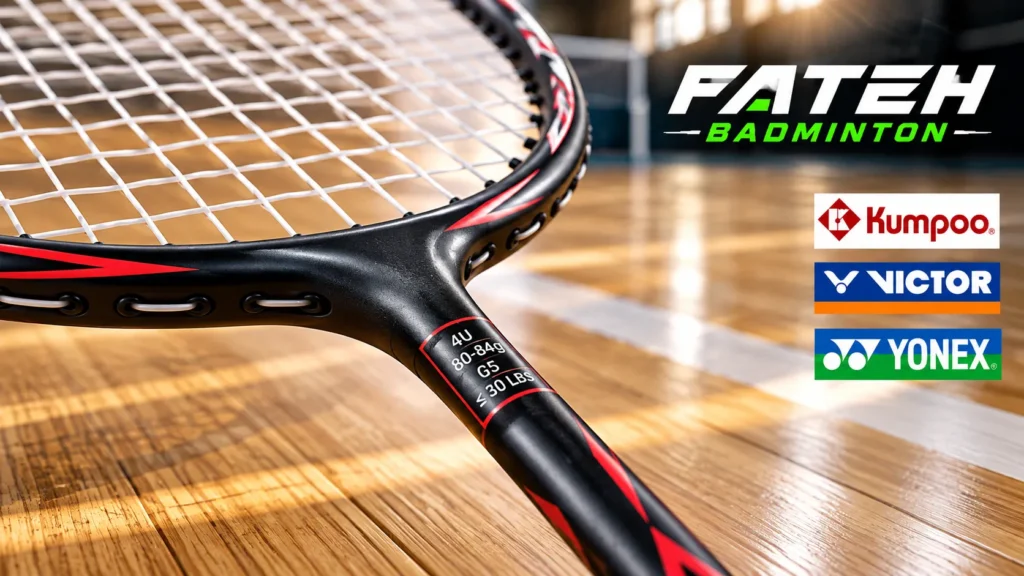
How to Choose a Badminton Racket in 7 Steps
Here is how to choose a badminton racket step by step. Follow the steps in order, and you never have to compare twenty rackets at once. [TEAM TO ADD: confirm this is the order you walk customers through on WhatsApp.]
- Be honest about your skill level. Beginner, intermediate or advanced decides how forgiving your racket needs to be.
- Pick a weight class. Choose 5U, 4U or 3U based on your strength and how long you play.
- Pick a balance for your style. Head-light for defence, even for all-round play, head-heavy for attack.
- Choose shaft flexibility. Flexible for developing swings, medium for most club players, stiff for fast, trained swings.
- Check the grip size. G4 or G5, remembering that an overgrip makes any handle thicker.
- Check max string tension. Know the frame’s limit and what tension it arrives strung at.
- Set your budget in PKR. Then decide whether a master copy or an authentic racket makes sense for you.
What Racket Weight Should You Choose: 3U, 4U or 5U?
Most adult club players should choose 4U, which is about 80–84 g. Choose 5U if you are a beginner, a junior or your arm tires easily. Choose 3U only if you already have a strong, well-trained swing.
A racket’s U rating is its weight class, usually printed on the shaft cone or the end of the handle. The smaller the number, the heavier the racket. In the common Yonex system, 3U is about 85–89 g, 4U about 80–84 g and 5U about 75–79 g before stringing.
| Rating | Approx. unstrung weight | Suits | Trade-off |
|---|---|---|---|
| 3U | 85–89 g | Strong, trained players; power in singles | Slower to swing; tiring over long sessions |
| 4U | 80–84 g | Most adult club players | A good middle ground |
| 5U | 75–79 g | Beginners, juniors, players with arm or shoulder strain | Less mass behind smashes |
Remember that strings, a grip and an overgrip all add weight. So your finished racket will always feel a little heavier than the label suggests. For 2U, 6U and the difference between static and swing weight, read our full 3U, 4U and 5U weight guide.
Weight also matters more than people expect on long club nights. After two or three hours in a hot hall, a lighter frame keeps your arm fresher and your late-game shots cleaner.
[TEAM TO ADD: weigh 2–3 of our rackets on a digital scale and note the measured weight next to the listed weight.]
Head-Heavy, Head-Light or Even Balance: Which Suits You?
Choose head-heavy if you love to smash, head-light if you defend and drive a lot, and even balance if you do a bit of everything or are still learning. Balance changes how a racket feels in your hand more than any other spec.
Balance point is measured in millimetres from the end of the handle; the higher the number, the more head-heavy the racket feels. Head-heavy rackets add momentum to smashes and clears, while head-light rackets are faster to swing for defence, drives and net play.
| Balance | Balance point (approx.) | Feels like | Best for | Watch out |
|---|---|---|---|---|
| Head-heavy | Above ~295 mm [VERIFY] | Momentum on smashes and clears | Attackers, singles, rear-court doubles | Slower defence at the net; harder on the shoulder |
| Even balance | ~285–295 mm [VERIFY] | Balanced power and speed | All-round players, mixed doubles, improvers | Not the best at either extreme |
| Head-light | Below ~285 mm [VERIFY] | Quick and easy to swing | Defence, drives, front-court doubles, beginners | Less free power on clears and smashes |
Once you know which balance suits you, shopping gets much easier. You can browse rackets by weight and balance on our Rackets page. To be upfront, most of our current rackets are head-heavy master copies, with a smaller choice of head-light and even-balance models.
Want to check a racket’s balance point yourself? We explain the method in [LINK WHEN PUBLISHED: head-heavy vs head-light vs even balance rackets].
Is a Heavier or Head-Heavy Racket More Powerful?
Only if you can swing it fast and on time. Extra mass in the head carries more momentum into the shuttle, but a racket that’s too heavy for you swings late and slow.
That late swing loses more power than the extra weight adds, and it loads your shoulder and elbow. Pick the heaviest balance you can control in a fast rally.
Flexible or Stiff Shaft: Which Is Right for You?
Choose a flexible shaft if your swing is still developing, and a stiffer shaft only once your swing is fast and consistent. Shaft flex is how much the shaft bends during your swing.
A flexible shaft bends more during the swing and helps slower swings generate power; a stiff shaft gives more control to fast, well-timed swings.
- Flexible: for beginners and casual players. It adds a little “kick” and forgives late timing.
- Medium: for most club and intermediate players. It balances power and control.
- Stiff: for advanced players with fast racket speed. It gives accurate, flat shots but feels harsh if your timing is off.
Honestly, many master-copy listings don’t state shaft flex. Rather than guess, message us and we’ll tell you what we know about a specific model. [VERIFY: flex rating for each master-copy model before stating it.] For the full explanation, see [LINK WHEN PUBLISHED: flexible vs stiff shaft explained].
Which Grip Size Should You Choose, G4 or G5?
Choose the grip that lets you hold the racket loosely and change grips quickly. If you plan to add an overgrip, many players end up happiest starting from the thinner G5.
Grip size (G size) describes how thick the handle is. In Yonex’s grip sizing, a higher G number means a thinner handle, so a G5 grip is thinner than a G4. Other brands label handles differently. [VERIFY: Li-Ning and Victor grip labelling.]
- Quick fit test: hold the racket in a forehand grip. Your fingertips should sit close to your palm without pressing into it.
- Thinner handle (G5): easier to twist between forehand and backhand, which suits fast wrist and finger play.
- Thicker handle (G4): feels more stable for players with larger hands.
In a Pakistani summer, sweaty hands are a real issue. Most players add an overgrip for that reason, and every layer makes the handle thicker. So factor the overgrip in before choosing. [TEAM TO ADD: which grip size our rackets come in.]
What Does “Max String Tension” Mean on a Racket?
Max string tension is the highest tension, in pounds (lbs), that the frame is designed to handle. It’s usually printed on the frame or shaft. The max string tension printed on a frame is the highest tension the maker recommends; stringing above it can crack the frame.
- Higher tension: more control and a crisp feel, but it needs a fast, clean swing.
- Lower tension: a bigger, more forgiving sweet spot and easier power for developing players.
Beginners are usually happier at lower tensions. When buying, check two things: the frame’s limit and the tension the racket arrives strung at. [TEAM TO ADD: whether our rackets ship pre-strung, and at what tension.] [VERIFY: the 30 lbs limit shown on some master-copy listings.]
Does Frame Material Matter? Graphite vs Aluminium
Yes. A graphite frame is much lighter and more responsive than aluminium or steel. Graphite, also called carbon fibre, is a light, stiff composite used in most proper badminton rackets.
Cheap aluminium and steel rackets are heavy, bend easily and make clean technique harder to learn. They’re fine for a casual garden game but not for regular club play.
Our product pages describe “carbon graphite-style construction”, and we use that wording rather than claiming “full graphite”. [VERIFY: exact frame composition.] More detail: [LINK WHEN PUBLISHED: graphite vs aluminium badminton racket].
How Do I Match a Racket to My Playing Style?
Match balance to how you win points. Attackers suit head-heavy rackets, defenders suit head-light ones, and all-round players suit even balance.
- Attack: you look for smashes and steep clears. Choose head-heavy, 4U or 3U, with a medium to stiff shaft.
- Defence: you enjoy retrieving, blocking and fast drives. Choose head-light, 4U or 5U.
- All-round: you switch between attack and defence. Choose even balance, usually 4U.
How Do I Know My Playing Style If I’m New?
Play regularly for a few weeks, then ask yourself these questions:
- Do you enjoy smashing more, or getting difficult shots back?
- In doubles, do you end up at the net or at the back?
- Do your points usually end at the net or from the back court?
- Do long, fast rallies tire your arm?
Until a clear style shows, stay with even or head-light balance. It keeps every shot easy while your technique settles.
Singles vs Doubles: Does It Change the Racket?
Yes, a little. Singles means full-court play and many clears, so plenty of singles players like head-heavy or even balance. Doubles is faster and flatter: front-court players suit head-light rackets, while rear-court attackers suit head-heavy ones.
Most rooftop and outdoor games in Pakistan are casual doubles. A quick, forgiving racket suits them far better than a stiff, head-heavy one. [TEAM TO ADD: confirm whether customers often buy very head-heavy rackets and then struggle in fast doubles.] For more, see [LINK WHEN PUBLISHED: badminton racket for singles vs doubles].
Which Racket Suits Your Skill Level?
Beginners need a light, forgiving racket, while advanced players can choose purely by role. Use this table as a starting point.
| Skill level | Weight | Balance | Shaft | Notes |
|---|---|---|---|---|
| Beginner | 5U or 4U | Head-light or even | Flexible | Forgiving; learn technique first |
| Intermediate | 4U | Even or mildly head-heavy | Medium | Choose by style once it’s clear |
| Advanced | 4U or 3U | By role (attack or defence) | Medium to stiff | Higher tension; needs a consistent swing |
How to Choose a Badminton Racket as a Beginner
Focus on weight and balance, and choose comfort over power. A light racket with even or head-light balance lets you learn the grip, the swing and the timing without straining your arm.
At Fateh Badminton, we usually recommend that new players start with a 4U or 5U racket in even or head-light balance, then move to head-heavy once their smash technique is consistent.
For specific options, see our picks for a first racket in Pakistan.
If your shoulder, elbow or wrist hurts after playing, try a lighter, more flexible racket and lower tension. If the pain keeps coming back, see a physiotherapist or doctor rather than changing rackets again. Intermediate and advanced players can read [LINK WHEN PUBLISHED: badminton racket for intermediate players] and [LINK WHEN PUBLISHED: choosing a racket as an advanced player].
How Much Should You Spend, and Master Copy or Authentic?
Spend enough to get a graphite racket with the right weight and balance for you. Beyond that, extra money mainly buys brand materials, exact factory specs and warranty, not a better game.
At Fateh Badminton, every racket is a master copy priced at PKR 4,999. [VERIFY: price at publishing.] Authentic flagship rackets from the big brands cost several times more. [VERIFY: current Pakistani retail prices before adding any number.]
You can pay cash on delivery. [VERIFY: whether customers can open the parcel before paying.] For a price-by-budget breakdown, see [LINK WHEN PUBLISHED: badminton racket price in Pakistan].
Master Copy or Authentic: Which Is Right for You?
A master copy is right if you want a specific weight and balance at a low price. An authentic racket is right if you compete seriously or need exact manufacturer specs and warranty.
- A master copy suits: beginners, casual and club players, anyone wanting a backup racket, and players testing a weight or balance before spending more.
- Authentic suits: tournament players, players stringing near the top of the tension range, and anyone who needs a manufacturer’s warranty.
Master-copy disclosure: A master copy is a replica built to look and play like a well-known model. The rackets we sell are master copies inspired by Yonex, Li-Ning and Victor models. They are not made or endorsed by those brands, and their specs can differ from the models they are based on.
Read what really separates authentic and master copy rackets before you decide.
Racket Choice at a Glance
This table sums up how to choose a badminton racket for each type of player. Find your type, then use the matching weight, balance and shaft.
| If you are… | Weight | Balance | Shaft |
|---|---|---|---|
| A beginner or casual player | 5U or 4U | Head-light or even | Flexible |
| An attacking singles player | 4U or 3U | Head-heavy | Medium to stiff |
| A front-court or defensive doubles player | 4U or 5U | Head-light | Medium |
| A rear-court doubles attacker | 4U | Head-heavy | Medium to stiff |
| An all-rounder or mixed doubles player | 4U | Even | Medium |
| Recovering from arm or shoulder strain | 5U | Head-light or even | Flexible |
Rackets at Fateh Badminton (Master Copies)
All rackets below are master copies (replicas) inspired by Yonex, Li-Ning and Victor models. They are not made or endorsed by those brands.
Our range covers each balance type. For attack, there are head-heavy frames such as the Yonex Astrox 88D Pro 4U master copy, listed at approximately 83 g.
For speed, there are head-light frames such as the Yonex Nanoflare 1000 Z master copy. The Yonex Arcsaber 7 Pro master copy is our even-balance all-rounder, listed at approximately 77–84 g. The Li-Ning Windstorm 74 master copy, at approximately 74 g, is our lightest option.
Each is PKR 4,999 [VERIFY], with cash on delivery. You can see close-up photos of our rackets on Instagram before you order.
- Good for: beginners, club players, casual doubles groups, backup rackets, and trying a new weight or balance cheaply.
- Not for: tournament players who need exact factory specs or warranty, anyone who strings above the frame’s safe limit, and anyone who needs the genuine brand product.
Frequently Asked Questions
Still unsure? You can also ask your racket question in our Facebook community.
What racket spec matters most for a beginner?
Weight and balance matter most for a beginner. A light 4U or 5U racket with even or head-light balance is easy to swing, forgives late timing and puts less strain on the arm.
Shaft flex comes next: a flexible shaft helps slower swings. Brand, colour and advanced features matter far less while you are still learning the basic strokes.
Does a heavier racket give you more power?
A heavier racket can give more power, but only if you swing it fast and on time. Power comes from racket speed as well as mass.
If the racket is too heavy for your strength, your swing slows and arrives late, so you lose power and control. Choose the heaviest racket you can still move quickly in a fast rally.
Should you choose a racket by brand or by specs?
Choose by specs first and brand second. At Fateh Badminton, we suggest settling weight, balance and shaft flex before you look at logos. Two rackets with matching specs will feel similar even from different brands.
Brand matters more for build quality, consistency and warranty, which is important mainly for competitive players.
How can a new player work out their playing style?
Play regularly for a few weeks and notice what you enjoy and where you stand. If you love smashing from the back, you lean towards attack. If you enjoy blocking and fast net exchanges, you lean towards defence.
If you do both, you are an all-rounder. Until it is clear, an even or head-light racket is the safest choice.
Will an expensive racket make you play better?
No, an expensive racket will not fix technique on its own. Footwork, grip and timing decide most points at club level.
A costly racket helps only when its specs suit your swing, and a stiff, head-heavy flagship can make a beginner play worse. Pick the right spec at a price you are comfortable with, then upgrade as you improve.
Is a master copy or an authentic racket better for me?
A master copy is usually enough for beginners, casual players and club players who want a particular weight and balance at a low price. An authentic racket is better for tournament players and anyone who needs exact factory specs, high-tension stringing or a manufacturer’s warranty. Master copies are replicas, so their specs can differ from the original models they copy.
Choosing Your Racket: The Short Version
Now you know how to choose a badminton racket: weight first, then balance, shaft flex, grip size, tension, frame material and budget. Match each choice to your level and style, not to what the pros use.
When you’re ready, our Rackets page lets you compare weights and balances in one place. If you’re still unsure, message us on WhatsApp for a weight and balance recommendation, and tell us your level, your style and whether you play singles or doubles.